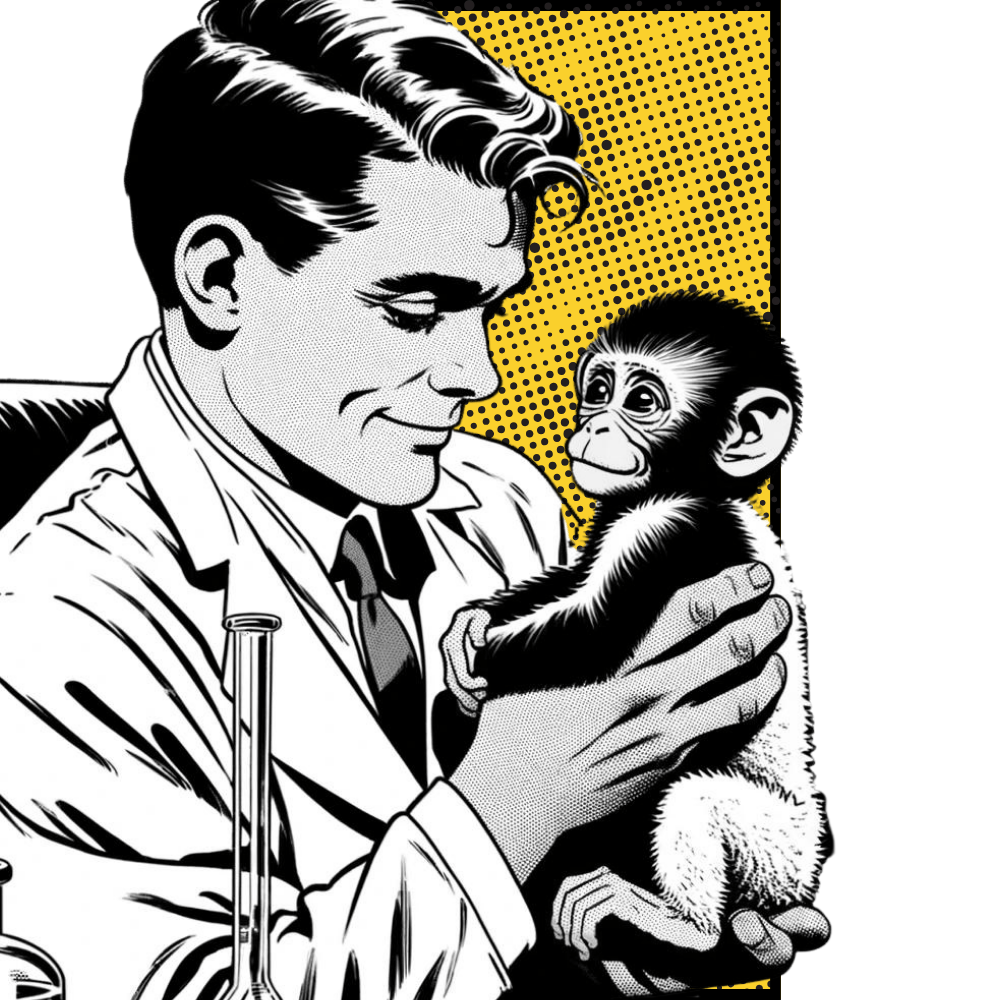
Harry Harlow, born on October 31, 1905, in Fairfield, Iowa, was a pioneering American psychologist whose work fundamentally altered our understanding of attachment, love, and social development. After receiving his Ph.D. from Stanford University, Harlow joined the faculty at the University of Wisconsin-Madison, where he spent most of his career studying the nature of relationships and emotional development among rhesus monkeys. His innovative approaches and thought-provoking findings continue to influence psychology, education, and parenting practices today.
Research
Harlow’s research in the mid-20th century challenged the then-prevailing theories that attachment was primarily based on the fulfillment of basic needs, such as hunger. In his most famous set of experiments, Harlow presented young monkeys with two surrogate mothers: one made of wire that provided food and another covered in soft cloth that offered no food. Contrary to expectations, the monkeys showed a strong preference for the comforting cloth surrogate over the nourishing wire surrogate, highlighting the importance of comfort, security, and warmth in the development of attachment.
Attachment Theory
The implications of Harlow’s research were profound, contributing significantly to the development of Attachment Theory. While John Bowlby is credited with formally developing Attachment Theory, Harlow’s work provided compelling empirical evidence supporting Bowlby’s ideas. Attachment Theory posits that the bonds formed between infants and their primary caregivers are crucial for survival and influence emotional and social development throughout life. Harlow’s findings underscored the importance of emotional and physical comfort in forming these bonds, challenging the notion that attachment was driven solely by biological needs.
Importance to Cognitive Behavioral Psychology
Harlow’s discoveries have had a lasting impact on cognitive behavioral psychology by emphasizing the critical role of early emotional experiences in shaping behavior and cognition. His work helped shift the focus toward understanding the psychological underpinnings of social and emotional development, influencing therapeutic approaches, child-rearing practices, and educational strategies. By demonstrating the profound effects of love, security, and early relationships on behavioral outcomes, Harlow’s research paved the way for integrating emotional and cognitive aspects into the behavioral sciences, enriching our understanding of human and animal psychology alike.
In conclusion, Harry Harlow’s pioneering experiments not only challenged existing paradigms but also laid the groundwork for future research in attachment, emotional well-being, and cognitive behavioral psychology. His legacy is a testament to the importance of warmth, affection, and secure relationships in the healthy development of individuals, insights that continue to inform and inspire across disciplines.
 MisterMiceGuy