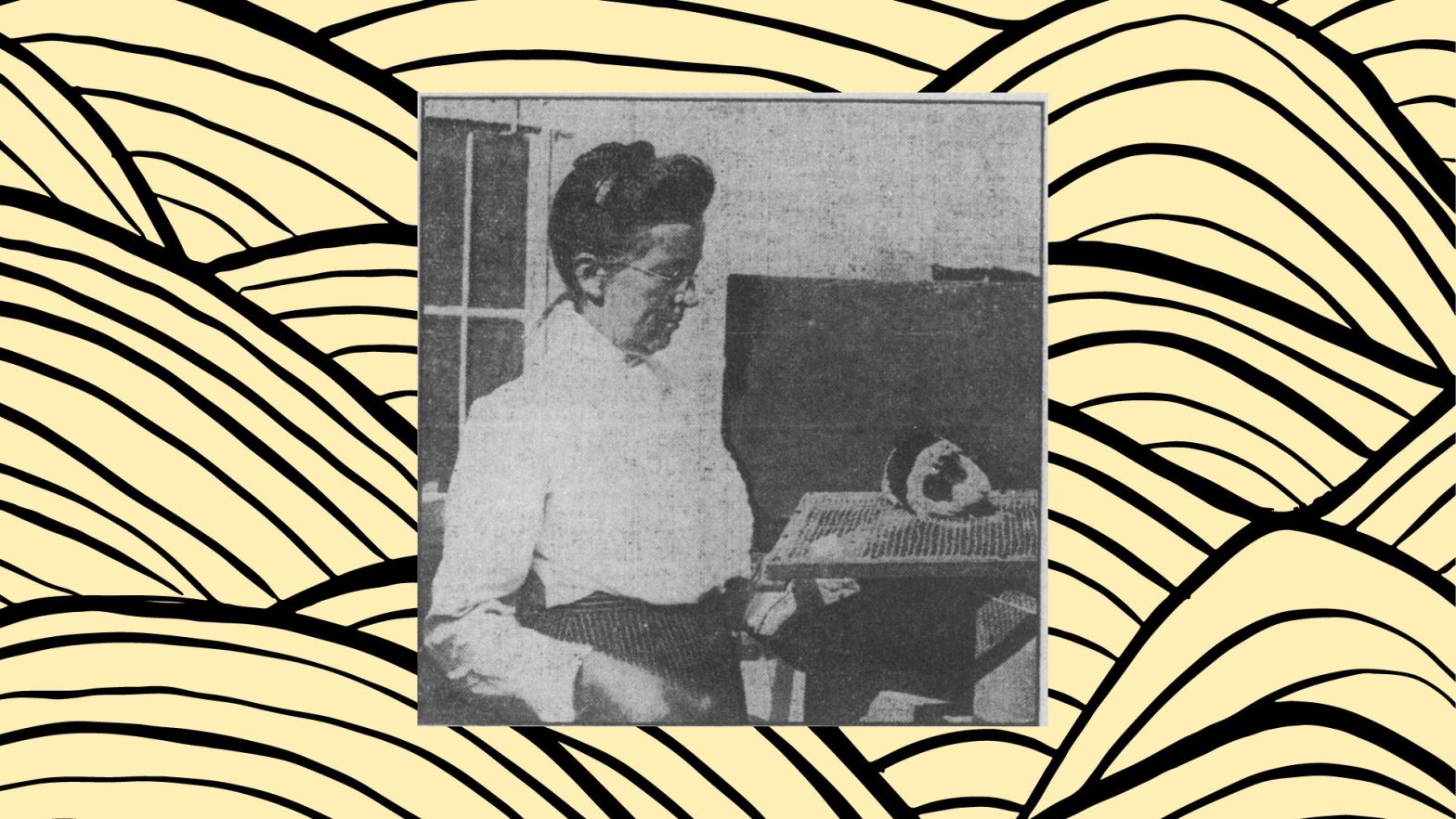
Abbie Lathrop

Abbie Lathrop, the “Mouse Woman of Granby”

Abbie Lathrop, a lesser-known yet pivotal figure in the history of genetic research and the domestication of laboratory mice, made significant contributions to the field of genetics and the development of the mouse as a key model organism. At the turn of the 20th century, Lathrop’s work laid the groundwork for the mice that are now integral to scientific research across various disciplines.

Early Life and The Granby Mouse Farm

In the early 1900s, Abbie Lathrop, a former school teacher and nurse, moved to Granby, Massachusetts, where she began breeding fancy mice as a hobby. Her venture quickly evolved into a scientific pursuit when she started to supply these mice to researchers. What made Lathrop’s mice particularly valuable was her meticulous observation of their traits and her efforts to breed them for specific characteristics, including coat colors, patterns, and behaviors.

Contributions to Genetic Research

Lathrop’s collaboration with scientists, most notably with William Ernest Castle and later with Clarence Cook Little, proved to be groundbreaking. Castle, a Harvard University geneticist, was among the first to recognize the potential of Lathrop’s mice for genetic studies. Together, they conducted experiments that contributed significantly to the understanding of Mendelian inheritance in mammals.

It was on Lathrop’s Granby farm that many genetic mutations and traits were first observed and cataloged. Her work facilitated the study of heredity and the emergence of the mouse as a premier model organism in genetic research. The controlled breeding and detailed record-keeping practiced by Lathrop provided a foundation for the development of inbred strains of mice, which are crucial for ensuring consistent results in genetic experiments.

Legacy and Impact

Abbie Lathrop’s contributions extend far beyond her lifetime. The mice from her Granby farm were foundational in the establishment of the Jackson Laboratory by Clarence Cook Little, who recognized the importance of genetically uniform mice for research. The Jackson Laboratory continues to be a leading center for genetic research, partly owing to the early contributions of Lathrop’s mice.

Abbie Lathrop’s work has had a lasting impact on biomedical research, genetics, and the development of treatments for human diseases. By providing mice with specific genetic traits, she helped pave the way for the use of mice in the study of cancer, genetics, developmental biology, and a host of other fields. Her dedication and foresight in breeding and observing these animals have made her an unsung hero in the scientific community.

Conclusion

While Abbie Lathrop may not be a household name, her contributions to the field of genetics and the domestication of laboratory mice have left an indelible mark on science. Her pioneering work in mouse breeding not only facilitated crucial genetic discoveries but also established the mouse as an essential model organism that continues to drive forward advancements in medical and genetic research today.

John B. Watson & Behaviorism

John B. Watson

General Background

John Broadus Watson (1878-1958) was an influential American psychologist who is often referred to as the father of behaviorism. Watson’s work laid the foundation for behavioral psychology, emphasizing the study of observable behavior over the study of the mind. Born in South Carolina, Watson grew up with an interest in psychology and earned his Ph.D. in psychology from the University of Chicago. His ideas were revolutionary for the time and paved the way for a new direction in psychological research and theory.

Research Contributions

Watson’s research initially focused on animal behavior, which he later applied to human psychology. He believed that psychology should be a science based on observable behavior, arguing against the introspective methods that were popular at the time. Watson’s emphasis on the environmental influence on behavior led to the development of the theory that all behaviors are acquired through conditioning.

Behaviorism

Behaviorism, as proposed by Watson, is a psychological perspective that focuses on observable behaviors instead of internal mental processes. Watson argued that behaviors could be measured, trained, and changed, making psychology a more scientifically valid field.

Little Albert Experiment

One of Watson’s most notable experiments was with an infant known as “Little Albert.” In this study, Watson and his graduate student, Rosalie Rayner, demonstrated that emotional responses could be conditioned in humans. They presented Little Albert with a white rat, which he initially showed no fear of, and then made a loud sound behind the baby’s back every time he touched the rat. Eventually, Little Albert developed a fear of the white rat and generalized this fear to other similar objects. This experiment provided evidence for the theory of classical conditioning in humans.

Impact on Cognitive Behavioral Psychology

Watson’s work on behaviorism and the Little Albert experiment had profound implications for the development of cognitive behavioral psychology. By focusing on observable behavior and the effects of the environment on behavior, Watson set the stage for later psychologists to explore how thoughts and feelings influence behavior. Cognitive behavioral psychology builds on these foundations, incorporating the idea that cognitive processes (thoughts, perceptions, and attitudes) and behaviors are interconnected and can be modified to treat psychological disorders.

Watson’s emphasis on scientific methodologies and experimental rigor also contributed to psychology’s development as a respected scientific discipline. His work encouraged further research into how behavior can be shaped and changed, leading to effective therapies for a wide range of psychological conditions. Watson’s legacy in psychology is profound, as his pioneering ideas on behaviorism have influenced countless research studies, theoretical developments, and clinical practices in the field of psychology.

Edward Tolman & Cognitive Maps

Edward Tolman

Edward Tolman was an influential figure in the field of psychology, leaving a lasting mark through his innovative approach to understanding behavior. Born in 1886, Tolman’s work straddled the early 20th century, a period ripe with scientific exploration into the human mind and its functions. As a psychologist, Tolman was not content with the reductionist views of behaviorism that dominated his time. Instead, he proposed a more nuanced approach to studying behavior, incorporating the concept of cognition long before the cognitive revolution took psychology by storm.

Tolman’s Research

At the core of Tolman’s research was the desire to understand the underlying cognitive processes that informed behavior. His studies were groundbreaking, challenging the then-prevailing stimulus-response (S-R) model that defined behaviorism. Tolman’s experiments, particularly with rats in mazes, demonstrated that behavior was not just a series of automatic responses to stimuli but was influenced by internal processes such as expectations, motivations, and goals.

Cognitive Maps

One of Tolman’s most significant contributions was the concept of “cognitive maps.” This idea emerged from his maze studies with rats, where he observed that the animals appeared to form mental representations of their environments. These “maps” allowed them to navigate mazes more efficiently over time, suggesting that they were not merely reacting to stimuli but actively processing information and using it to guide their actions.

Latent Learning

Linked to his work on cognitive maps, Tolman introduced the concept of “latent learning.” He discovered that rats could learn the layout of a maze without any apparent reinforcement or rewards, only demonstrating their knowledge when a motivation (like food) was introduced. This finding was revolutionary, indicating that learning could occur without direct reinforcement, challenging the behaviorist notion that reinforcement was necessary for learning to take place.

Purposive Behaviorism

Tolman’s theory of “Purposive Behaviorism” or “Sign-Gestalt Theory” posited that behavior is goal-directed and purposeful, driven by the intentions and purposes of the individual rather than merely by external stimuli. This approach bridged the gap between behaviorism and cognitive theories, highlighting the importance of internal states and cognition in understanding behavior.

Impact on Cognitive Behavioral Psychology

Edward Tolman’s work laid foundational stones for the field of cognitive psychology and had profound implications for cognitive behavioral psychology. By introducing concepts like cognitive maps, latent learning, and purposive behavior, Tolman shifted the focus from external behaviors to the internal cognitive processes that drive them. His emphasis on the purposive and goal-directed nature of behavior helped pave the way for a more comprehensive understanding of the human mind, influencing therapeutic approaches and educational strategies that recognize the role of cognition in shaping behavior.

Tolman’s legacy in psychology is a testament to the importance of looking beyond observable behavior to understand the complex workings of the mind. His contributions continue to influence psychological theory and practice, highlighting the intricate interplay between cognition and behavior that defines human experience.

Edward Thorndike & The Law of Effect

Edward Thorndike: The Pioneer of Learning Theory

Edward Lee Thorndike, a name synonymous with the evolution of educational psychology, carved a niche for himself in the early 20th century with groundbreaking research that continues to influence the field today. Born in 1874 in Williamsburg, Massachusetts, Thorndike’s educational journey led him to Wesleyan University, Harvard, and finally Columbia University, where he completed his Ph.D. under the mentorship of James McKeen Cattell. His pioneering work laid the foundation for modern educational psychology, behavioral psychology, and the scientific approach to the study of learning processes.

Puzzle Box Experiments: Unlocking Animal Intelligence

Thorndike’s fascination with understanding how animals learn led to the development of his famous “puzzle box” experiments. These experiments involved placing cats in a series of boxes designed to be opened by pulling a lever or string. Initially, the cats struggled to escape, but over time, they began to associate the action of pulling the lever with the reward of freedom (and occasionally, food). These observations were meticulous, with Thorndike carefully noting the duration it took for the cats to escape on each trial.

Law of Effect: The Cornerstone of Behaviorism

From these experiments, Thorndike formulated the “Law of Effect,” a principle stating that responses to a situation that are followed by satisfaction (i.e., a reward) become more strongly associated with the situation and are more likely to recur in the future. Conversely, responses followed by discomfort or an unsatisfactory outcome are less likely to occur again. This principle was revolutionary, suggesting that behavior is largely a product of its consequences, laying the groundwork for behaviorism and the study of operant conditioning.

The Impact of Thorndike’s Work

Thorndike’s discoveries and perspectives were monumental for several reasons. Firstly, they introduced the concept of trial-and-error learning, illustrating that intelligence could be studied through observable behavior rather than introspection. Secondly, the Law of Effect prefigured B.F. Skinner’s work on operant conditioning, emphasizing the importance of reinforcement and punishment in learning. Lastly, Thorndike’s focus on the scientific study of education transformed teaching methodologies, advocating for evidence-based practices and the application of psychological principles to enhance learning outcomes.

Edward Thorndike’s legacy is a testament to the power of empirical research in understanding the complexities of learning and behavior. His work not only paved the way for future generations of psychologists but also fundamentally changed the way educators approach teaching and learning. Through his puzzle box experiments and the formulation of the Law of Effect, Thorndike offered profound insights into the mechanics of learning, reinforcing the idea that our interactions with the environment shape who we become.