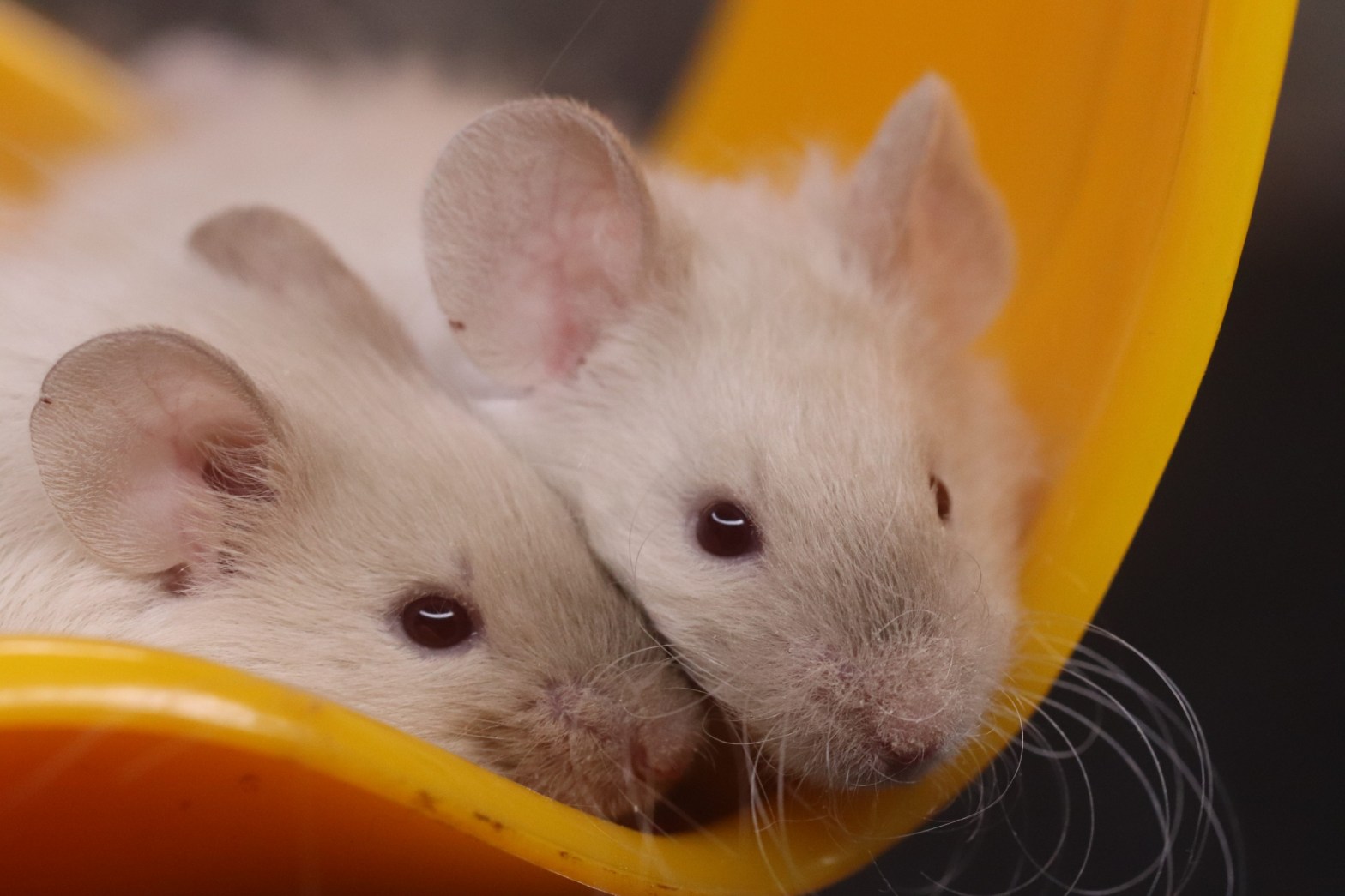
The Himalayan gene produces a phenotype characterized by having a light-colored or white body with dark extremities. The phenotype is sometimes also known as “Siamese” and is seen is species such as rabbits, cats, guinea pigs, and hamsters. (Green, n.d.)
Reportedly, an early or possibly the first description of a mouse with the appearance of the Himalayan gene was recorded in 1939 on a German island by E. Mohr. However, I have not been able to access this German reference. Another mouse that had a wildtype color but slowly changed into a Himalayan appearance after about five months of age was described but it did not produce any offspring that possessed the trait (Dickie, 1944).
Subsequently, (Green, n.d.). described the appearance of what appears to be the Himalayan gene in the mouse hobby. It occurred in a litter of seven pups produced at the Jackson Memorial Laboratory and identified by Madeline Jewett. They describe the phenotype as starting white, like an albino, but the points become progressively darker with each molt. The darkness of the points is also described as being temperature-sensitive. Additionally, the eyes are described as unpigmented at birth but becoming progressively darker with age and are ruby colored at weaning. Testing breeding at the time proved that the Himalayan gene was a c-series albino gene, and it was given the symbol ch (Green, n.d.).
It’s possible, in fact it’s likely, that the Himalayan gene in mice causes alterations in brain development and in the neural projections coming from the retina causing an altered visual perception, possibly loss of depth perception (Jeffery et al., 1994; Kaas, 2005). However, it should be noted that while mice do normally possess binocular depth perception (Boone et al., 2021), the loss of it might not be obvious just as it’s not obvious in domestic cats (Kaas, n.d.).
References
Jeffery, g, Schuts, g, & Montolu, l. (1994). Correction of abnormal retinal pathways found with albinism by introduction of a functional tyrosinase gene in transgenic mice. Developmental Biology, 166, 460–464.
Boone, H. C., Samonds, J. M., Crouse, E. C., Barr, C., Priebe, N. J., & McGee, A. W. (2021). Natural binocular depth discrimination behavior in mice explained by visual cortical activity. Current Biology, 31(10), 2191-2198.e3. https://doi.org/10.1016/j.cub.2021.02.031
Dickie, M. M. (1944). A UNIQUE “HIMALAYAN” MOUSE. Journal of Heredity . https://academic.oup.com/jhered/article/36/9/265/872245
Green, M. C. (n.d.). HIMALAYAN, A NEW ALLELE OF ALBINO IN THE MOUSE HIMALAYAN MOUSE. https://academic.oup.com/jhered/article/52/2/73/757038
Kaas, J. H. (2005). Serendipity and the Siamese Cat: The Discovery That Genes for Coat and Eye Pigment Affect the Brain. ILAR Journal, 46(5). https://academic.oup.com/ilarjournal/article/46/4/357/656824
 MisterMiceGuy